
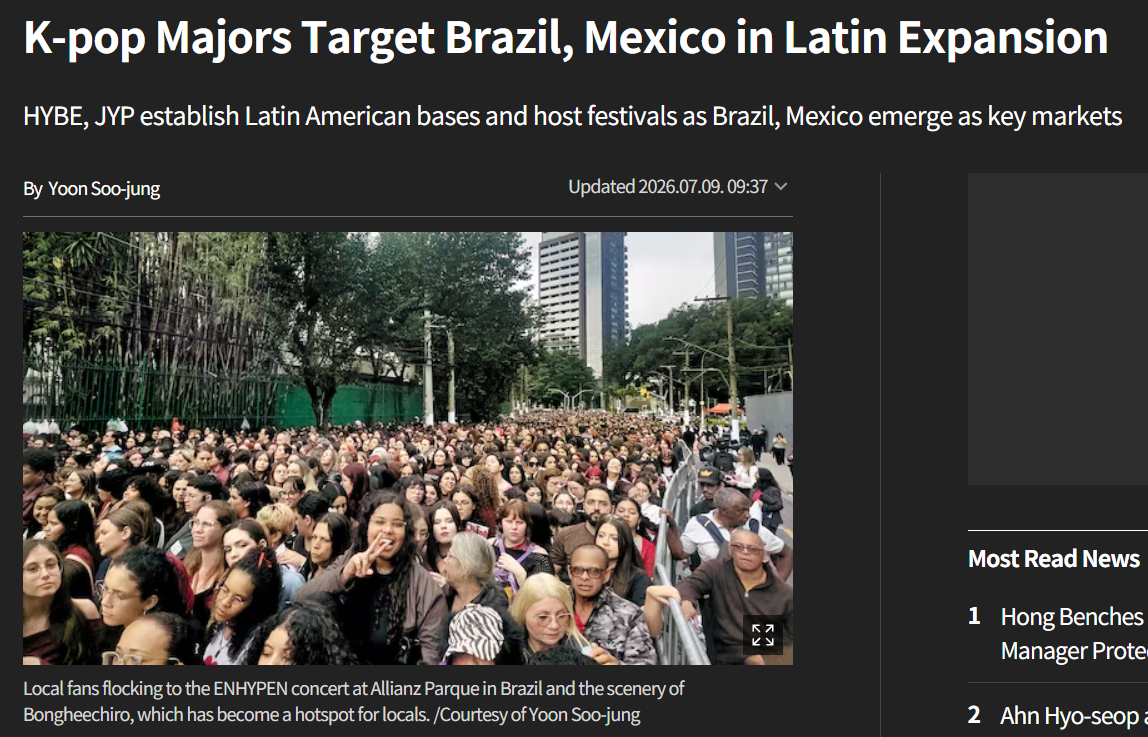
Even before the pandemic, Brazil and other Latin American countries were noted as markets with a strong response to K-pop. Smaller to mid-sized agencies such as LL Entertainment, Ellie Ellie Entertainment, and DR Music were the first to explore these markets. At the time, K-pop was considered a niche culture among local enthusiasts, and the long physical distance and logistics costs prevented significant profits.
In contrast, major agencies have recently been rapidly expanding their presence. HYBE established ‘HYBE Latin America’ in Mexico in 2023, and JYP announced the establishment of ‘JYP Latin America’ in 2024. JYP will also host its self-produced music festival, ‘STRAYCITY,’ in Colombia, Argentina, and Mexico in September. Stray Kids will serve as the headliner for all editions, with the lineup featuring JYP artists and local performers.
Korea Creative Content Agency has also expanded its Latin American bases. Following Mexico and Argentina in 2024, it opened a business center in São Paulo, Brazil, in 2025. Park Woong-jin, head of Korea Creative Content Agency’s Brazil Business Center, said, “YG is also in discussions about Baby Monster’s entry into the Brazilian market.” He added, “While the market has not yet shown visible profits, it is seen as having high future value not only for K-pop but also for games, webtoons, and other fields.”
The key markets attracting attention are Mexico and Brazil. According to the International Federation of the Phonographic Industry’s (IFPI) 2026 report, Latin America was the world’s fastest-growing recorded music market in 2025, with 88.1% of sales coming from streaming. Brazil ranks 8th and Mexico 10th globally in music market size, while South Korea is 7th. Mexico serves as a hub connecting the Spanish-speaking Latin music market and the Hispanic population in North America. Brazil, despite its linguistic uniqueness as a Portuguese-speaking nation, is recognized as South America’s largest music and content market. According to Luminate, a music data company, the share of on-demand audio streaming in the U.S. market by language in the first quarter of this year was 86% English, 9.5% Spanish, and 1.1% Korean.
However, unexpected confusion has arisen during the spread of the Korean Wave (Hallyu). A notable example is the Brazilian Academy of Letters’ (ABL) 2023 decision to register ‘Dorama’—a Japanese pronunciation—as a Portuguese neologism encompassing dramas from East and Southeast Asia, including Korea. According to a report by the Korea International Cultural Exchange Promotion Agency, the term ‘Dorama’ is increasingly used for Korean dramas not only in Brazil but also in other Latin American countries like Mexico. Shim Jong-woo, secretary-general of the São Paulo Korean Association, said, “We once protested at a Korean Wave festival organized by locals after they displayed the Rising Sun Flag alongside the South Korean flag.” Daniela Mazur, a communications professor at Fluminense Federal University in Brazil, stated, “Using symbols of Japan and China while introducing Korean content is an example of Brazil’s persistent Orientalist consumption.” She emphasized, “When distributing Korean Wave cultural products, it is necessary to also convey their historical context.”